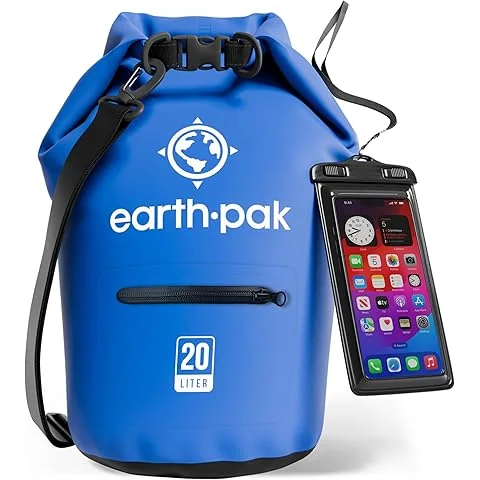
Earth Pak Waterproof Roll-Top Dry Bag
A kayak will ship water. A canoe will take spray. A beach bag left near the tide line will get soaked. A roll-top dry bag doesn't care about any of that.
View on AmazonAvailable on Amazon — ships fast.
Why your regular bag fails on water
Standard backpacks and beach bags are water resistant at best — the zippers and seams pass water under sustained contact. A kayak paddle dripping onto the deck, a rogue wave at a coastal beach, or a canoe that takes on six inches of water in a rapid will soak through a regular bag within minutes. The contents — phone, wallet, car keys, a dry change of clothes for the drive home — are typically destroyed or damaged. This isn't a low-probability event on Florida and Georgia water activities; it's the expected condition. A roll-top dry bag eliminates the calculation entirely: you roll the top three to five times and the seal holds in full submersion, not just splashes.
What we looked at first
We looked at waterproof pouches (the phone-sized clear case style) and the coverage problem is obvious — they fit a phone and a credit card, not a full day's worth of gear and a change of clothes. We looked at waterproof backpacks with zipper closures (MARCHWAY, Aqua Quest) and found consistent reviewer reports that the zippers eventually admit water at the corners under full submersion, which means they're splash-proof but not waterproof in the category that actually matters for kayaking. We looked at Pelican and similar hard cases — excellent protection but rigid, heavy, and impractical for anything more than a camera.
What you get
- Roll-top closure with buckle — three to five rolls creates a waterproof seal that holds in full submersion (IPX8 rated), not just splash resistance
- 500D PVC tarpaulin construction — the material that doesn't puncture on rocky riverbanks or abrade against kayak hulls
- D-ring at the top for tethering to a kayak, canoe, or paddle board — prevents loss in a capsize
- Available in multiple colors — roll-top bags in bright colors are highly visible in water and genuinely more recoverable after a capsize
Who this is for
This is for any traveler whose itinerary includes kayaking, canoeing, paddleboarding, tubing, or snorkeling — which covers a large share of Florida and coastal Georgia activities. It's also for the beach traveler who wants a dry storage option for the tide zone, and for the river hiker doing multiple creek crossings where the daypack may be submerged. The practical question is: will your bag get wet today? If yes, a dry bag is not a luxury — it's the only option that actually works.
Where to use it on your trip
At Three Sisters Springs in Crystal River, Florida, the kayak paddle from the public launch to the swim area crosses open water where paddle splash is constant — your phone and keys go in the dry bag from the moment you leave the dock. On the Florida Keys Overseas Heritage Trail, the coastal exposure means sudden squalls and spray at any point — the dry bag keeps documents, electronics, and a dry shirt protected throughout. On the Tallulah River in Georgia, the gorge floor permit trail crosses the river twice on exposed rock — a dry bag on your back keeps your gear sealed for the crossing and your phone dry for the photos on the other side.
Who should skip it
If your trip is entirely land-based — hiking, city tourism, road trips without water activities — a dry bag has no application. Skip it for beach days where you'll stay above the tide line and your gear never gets within reach of water. The investment is specifically for activities where immersion or sustained spray is part of the plan.
Our take
Buy this before any Florida water activity — kayaking, tubing, paddleboarding, snorkeling, or spring swimming with a phone and keys to protect. It's the only closure type that actually keeps electronics dry in real immersion conditions, and at $20–$30, it costs less than replacing a phone. Skip it for strictly dry-land travel where waterproofing solves a problem that doesn't exist.
Ready to get it?
Available on Amazon — ships fast.
View on AmazonWe may earn a commission if you purchase through our link, at no extra cost to you.