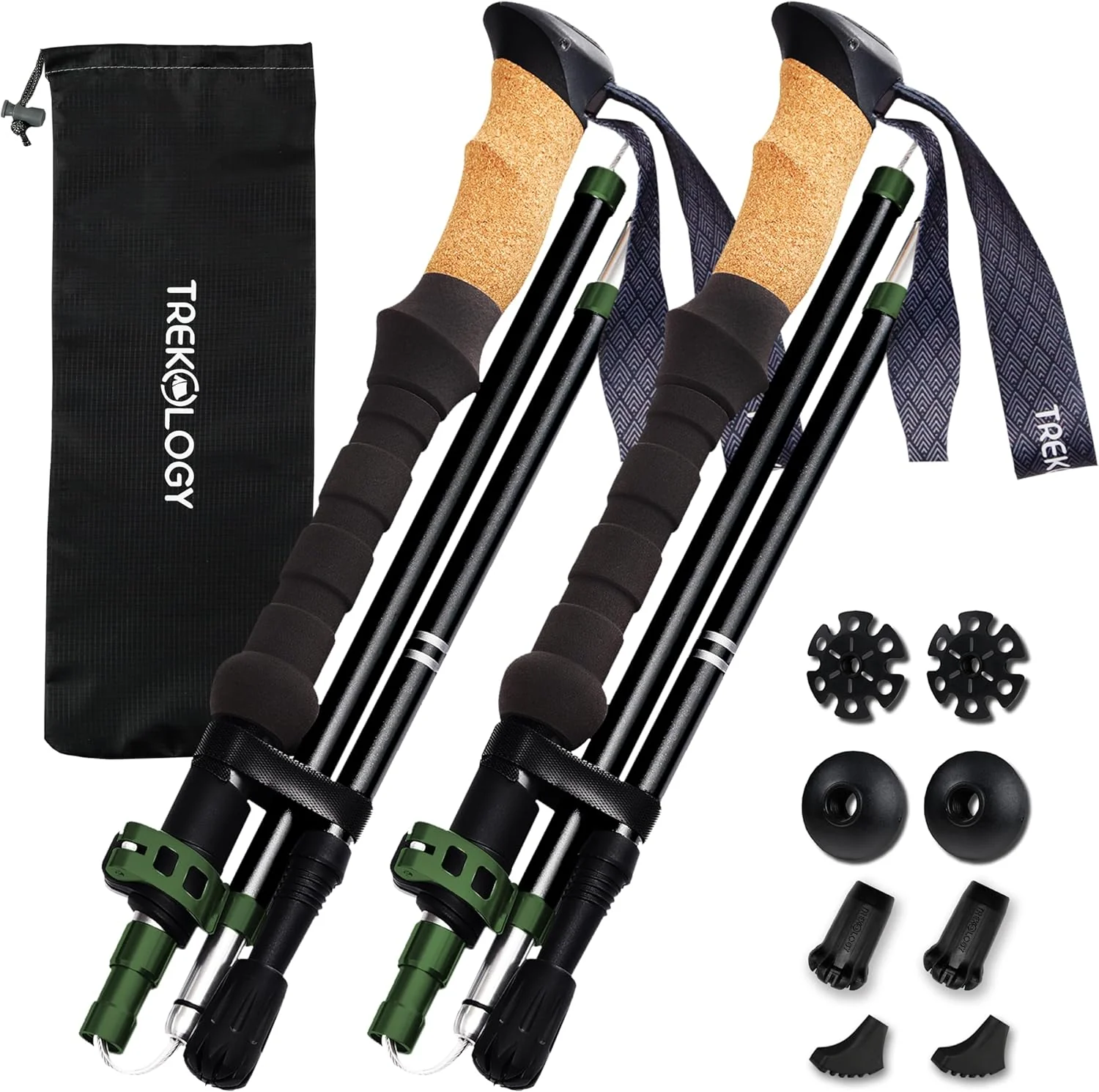
Collapsible Trekking Poles
On the Tallulah Gorge descent, the switchbacks are steep enough that trekking poles shift work from your knees to your arms — and your knees will thank you on day three.
View on AmazonAvailable on Amazon — ships fast.
What trekking poles actually do
Trekking poles are not a stability accessory for people who struggle on flat ground. They are a load-transfer tool for steep terrain: on a descent, planted poles shift 20–25% of the braking force from your knee joints to your arms and core. Over a long descent — 1,000 feet down a switchback trail, across multiple miles — that load transfer is the difference between arriving at the trailhead feeling fine and arriving with knees that hurt for two days. The biomechanics are documented across multiple sports medicine studies. The 63,000+ Amazon reviews on Cascade Mountain Tech poles confirm that people who buy them do not stop using them.
What we looked at first
Black Diamond Trail Ergo Cork is the performance benchmark — ergonomic cork grip that doesn't blister even in wet conditions, aircraft-grade aluminum shaft, and $70–$90 per pair. The right investment if you hike 30+ days per year. Carbon fiber poles (Leki, Black Diamond Distance Carbon) are ultralight and expensive — the choice for serious thru-hikers where every ounce is calculated. We looked at cheap fixed-length wooden hiking sticks and found that the inability to adjust length for uphill vs. downhill is a meaningful performance gap, and the lack of wrist straps eliminates the load-transfer benefit entirely. The Cascade Mountain Tech aluminum poles have 63,000+ reviews because they deliver the functional core — adjustable length, wrist straps, carbide tips — at $30–$40.
What you get
- Adjustable length — shorter for uphill (less reach needed), longer for downhill (more braking leverage)
- Wrist straps — allow pole push-off without gripping, which is how the load transfer actually works
- Carbide steel tips — grip rock, root, and packed dirt on Southern Appalachian trail surfaces
- Collapses to 15 inches — fits inside a pack or straps outside, checked luggage compatible
Who this is for
This is for any hiker whose itinerary includes a trail with significant elevation change — more than 500 feet of descent over more than a mile. It's for hikers over 35 who notice knee soreness the day after a steep hike. It's for anyone planning a multi-day hiking trip where knee fatigue on day one affects capacity on day three. It's not just for older hikers — trail runners use poles on technical terrain for stability, not just load management.
Where to use it on your trip
At Tallulah Gorge State Park in Georgia, the gorge floor trail descends over 1,000 feet via steep switchbacks to reach the river — this is exactly the terrain for which trekking poles exist, and the return climb benefits equally from the uphill push-off. On Chimney Tops Trail in Great Smoky Mountains National Park, the final 0.8 miles to the summit gains 800 feet at a sustained steep grade before opening onto exposed rock — poles help on the way up and are critical for stability on the rocky scramble back down. On the Catskill Mountain trails in New York — Hunter Mountain, Slide Mountain, Kaaterskill Falls — the trails are rocky, root-crossed, and wet in a way that makes the extra balance point worth carrying.
Who should skip it
Flat-trail hikers and nature walkers on developed paths where terrain is controlled — trekking poles add no benefit on a flat boardwalk or a groomed nature trail. Day hikers on short, easy trails under 5 miles with minimal elevation change. Anyone who has tried poles before and found them more distracting than helpful.
Our take
Buy these for any hike with more than 500 feet of descent — the knee load reduction is real and cumulative over a multi-day trip. Skip them for flat and gentle trails where the poles would spend the whole hike strapped to the pack.
Ready to get it?
Available on Amazon — ships fast.
View on AmazonWe may earn a commission if you purchase through our link, at no extra cost to you.