LifeStraw Personal Water Filter
Georgia and Tennessee mountain streams look clean and run cold. They are not safe to drink without filtration. LifeStraw makes filtration take two seconds.
Why clear mountain water isn't safe to drink
The Georgia and Tennessee mountain stream system carries giardia and cryptosporidium — microscopic parasites that cause acute gastrointestinal illness — at levels high enough that drinking untreated water is a genuine risk, not a theoretical one. These parasites are invisible, odorless, and tasteless in clear, cold mountain water. The symptoms of giardia infection (severe diarrhea, nausea, cramps) begin one to three weeks after exposure, which means you'll be home before you connect the illness to the trail water. Every backcountry hiking guide for Georgia and Tennessee recommends treating all natural water, including springs and moving streams. LifeStraw makes the treatment process fast enough that it doesn't slow down the hike — you drink through the filter like a straw, and the filtration happens in the time it takes to take a sip.
What we looked at first
We looked at iodine and chlorine tablets and ruled them out for regular trail use — they add a chemical taste that makes treated water actively unpleasant to drink, which leads to reduced hydration when people avoid drinking as much as they should. We looked at the Sawyer Squeeze and Sawyer Mini (strong alternatives that attach to standard water bottles) and they're excellent — the Sawyer filters more water per lifespan (100,000 gallons vs. LifeStraw's 1,000) and attaches to a bottle for easier use. The LifeStraw's advantage is price and simplicity for occasional backcountry use — the Sawyer is the better choice for through-hikers and frequent backcountry campers. We looked at pump filters and UV purifiers (SteriPen) and found them excellent but slower and more expensive — right for international travel or severe water quality conditions, overkill for Southern Appalachian day hike and overnight use.
What you get
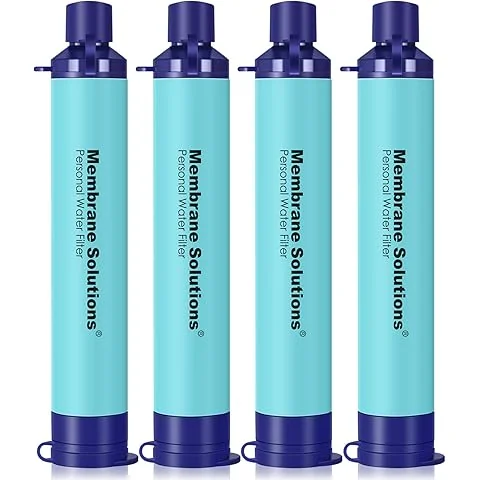
- Removes 99.9999% of bacteria (E. coli, Salmonella) and 99.9% of protozoa (Giardia, Cryptosporidium) — the two primary pathogen categories in Southern Appalachian backcountry water
- 1,000 liter (264 gallon) lifetime — enough for a season of day hiking and overnight backcountry use before replacement is needed
- No chemicals, no batteries, no moving parts — works on first use and continues working until the filter media is exhausted
- 4 ounce weight — adds nothing meaningful to a day pack; fits in a side pocket with a protein bar
Who this is for
This is for the backcountry hiker doing trails where the nearest water source is a natural stream and carrying enough water for the full day is not realistic — specifically, any trail over six miles in the Georgia or Tennessee backcountry where refilling from a creek is the practical option. It's for Appalachian Trail section hikers, overnight campers at primitive sites, and day hikers doing extended loops where they'll cross multiple water sources. It's not for hikers on developed trails with water stations and fountain access.
Where to use it on your trip
On extended trail sections in Great Smoky Mountains National Park in Tennessee — the backcountry permit system requires primitive camping miles from the nearest visitor center — creek water is the only reliable source, and the LifeStraw is how you use it safely. In the Chattahoochee National Forest in northern Georgia, which contains the southern terminus of the Appalachian Trail and hundreds of miles of backcountry trail, natural water sources are abundant but untreated. At Cloudland Canyon State Park in Georgia, the canyon rim and backcountry campsites access water from creeks in the canyon — a filter is standard equipment for overnight use here.
Who should skip it
Car campers at developed campgrounds with potable water stations don't need a personal water filter — the infrastructure provides treated water at the source. Day hikers on short trails (under five miles) who carry enough water for the hike in their pack don't need to filter from natural sources. If your hiking stays on developed interpretive trails near visitor centers, the LifeStraw is dead weight.
Our take
Buy this before any backcountry overnight or multi-day primitive camping trip in Georgia or Tennessee — the cost of treatment is trivial compared to the cost of a giardia infection that surfaces three weeks after you're home. For day hikers doing extended loops who may need to refill from creeks, the LifeStraw is the lightest and simplest solution. Skip it for developed campground camping and short trail day hikes where you carry sufficient water from the trailhead.
We may earn a commission if you purchase through our link, at no extra cost to you.