Foldable Solar Panel Charger
Three days without power is a real possibility at a dispersed campsite — a solar panel turns sunlight into a full phone charge while you hike.
The power problem nobody prepares for
A standard 20,000mAh power bank charges a phone three or four times. That sounds like enough until you're using navigation apps, recording video, and leaving the screen on at the campfire — and you're burning through a full charge per day. On a two-night trip it's fine. On a four-day backcountry stretch or a dispersed camping site with no hookups, you're managing power like a resource on day three. A solar panel doesn't replace a power bank — it refills it. Clip it to the top of your pack during the hike, plug in the power bank, and arrive at camp with a full battery instead of a dead one.
What we looked at first
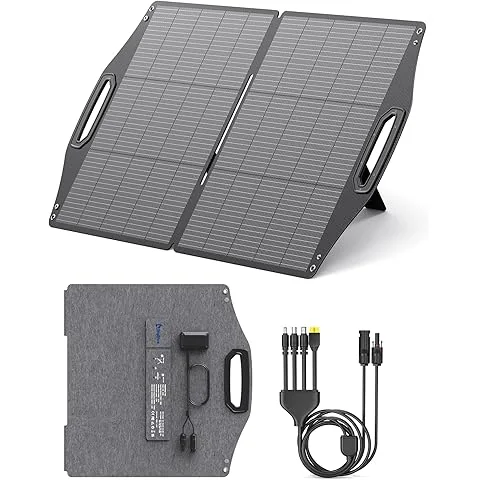
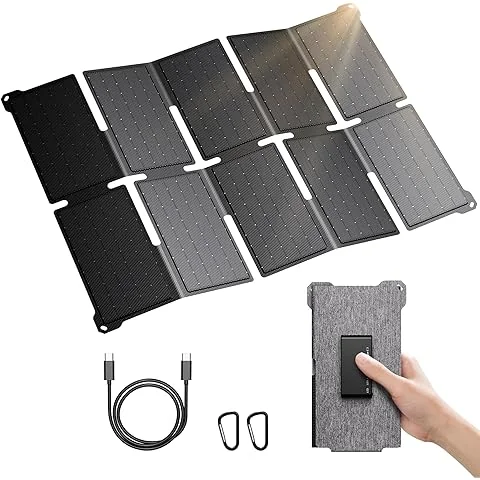
Goal Zero Nomad panels are the category benchmark — high-quality SunPower cells, reliable build, and a complete ecosystem of compatible batteries. They also start at $80–$120 for the panels alone, before you buy a battery. We looked at cheap solar panels under $20 and found the problem is conversion efficiency: cheap polysilicon cells charge at 3–4W in real-world sun conditions, which is barely faster than not charging at all. The BigBlue 28W uses SunPower cells — the same cell technology as Goal Zero — in a panel that folds to 8x5 inches and is priced at $30–$50. It charges a phone from 0 to 80% in about three hours of direct sun, which is consistent with the manufacturer claims and confirmed across 9,000+ reviews.
What you get
- 28W SunPower cell efficiency — charges 2–3x faster than cheap polysilicon alternatives in the same sunlight
- Dual USB-A and USB-C ports — charge a power bank and a camera battery simultaneously
- Built-in ammeter shows actual charge rate — tells you whether you're in direct sun or losing output to shade
- Folds to 8x5 inches and clips to a pack via corner loops — charges while you hike, not just while you sit
Who this is for
This is for the camper who spends three or more nights away from electrical hookups — dispersed sites in national forests, primitive campgrounds, backcountry areas. It's for the person who uses their phone heavily for navigation, photography, and emergency contact on multi-day trips where a single power bank isn't enough. It's for the backpacker approaching the AT from Amicalola Falls who will be out of cell range and electrical access for five or more days. If you camp exclusively at RV parks with hookups, this solves a problem you don't have.
Where to use it on your trip
At dispersed campsites in Chattahoochee National Forest in northern Georgia, there are no facilities of any kind — no water, no power, no hookups. Multi-night stays there require you to bring everything in, including power management. On the AT Approach Trail from Amicalola Falls State Park, the 8.5-mile corridor to the Georgia AT has no electrical access for 65 miles until the first road crossing at Woody Gap — a solar panel is the only realistic charging option for a multi-day hike. At Myakka River State Park's backcountry primitive camping area in Florida, the sites are accessible only by trail or kayak with no facilities.
Who should skip it
Car campers and RV users at campgrounds with electrical hookups — you don't need it. Backpackers who minimize electronics and carry a small lithium battery as the only backup — a 10,000mAh bank adds less weight than a panel for a one-night trip. This is most useful starting at three or more nights off-grid.
Our take
Buy this if you're planning three or more nights at a primitive or dispersed campsite where power isn't available — it turns a real logistics problem into a non-issue. Skip it for shorter trips where a standard power bank gets you through.
We may earn a commission if you purchase through our link, at no extra cost to you.