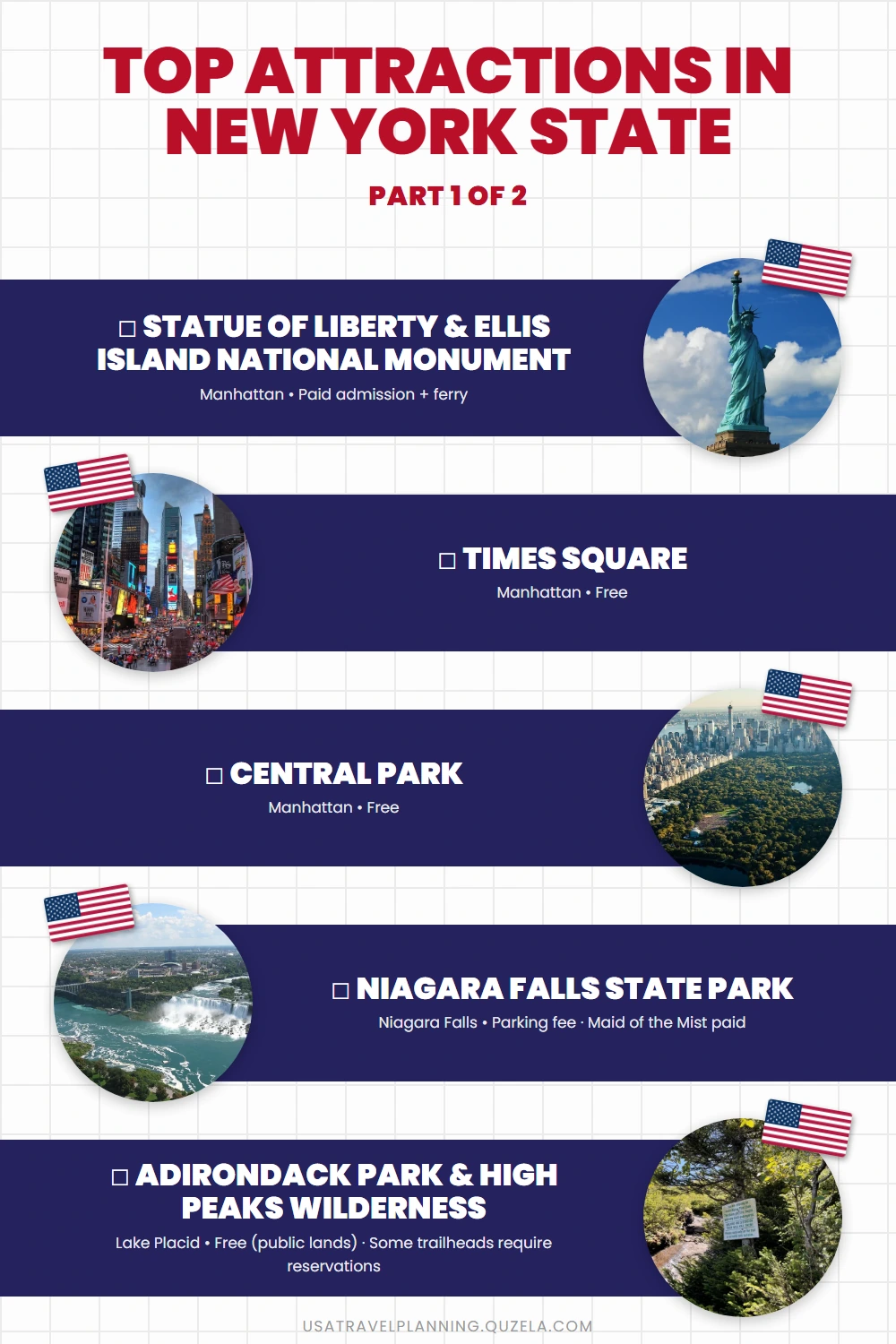
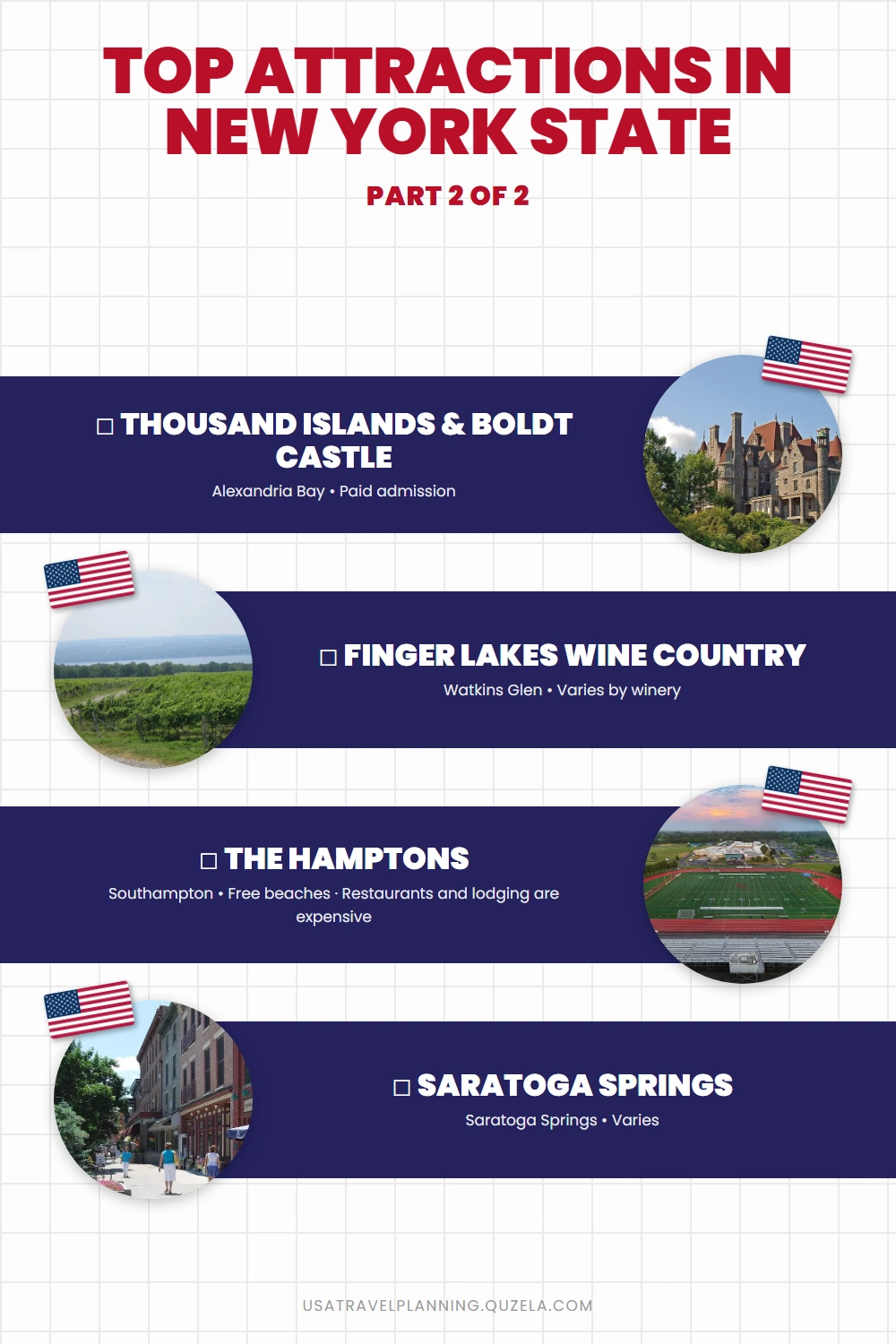
New York's major attractions operate at a scale that separates them from comparable sites in other states. Central Park is 843 acres — a larger urban park than most American cities' entire park systems. Adirondack Park is bigger than six US states. Niagara Falls pulls 8 million visitors a year to a corner of the state most tourists skip otherwise.
The nine sites below are the destinations that anchor most New York itineraries. They're organized from New York City outward so you can plan around your entry point.
9 destinations selected from a curated US travel dataset — prioritized by regional distribution, visitor significance, and independent research. Must-see and Worth-the-detour ratings reflect relative value within New_york.
Jump to: New York City · Western New York · Adirondacks & North Country · Finger Lakes & Eastern Long Island · Planning Notes
New York City
Statue of Liberty & Ellis Island National Monument Must-see
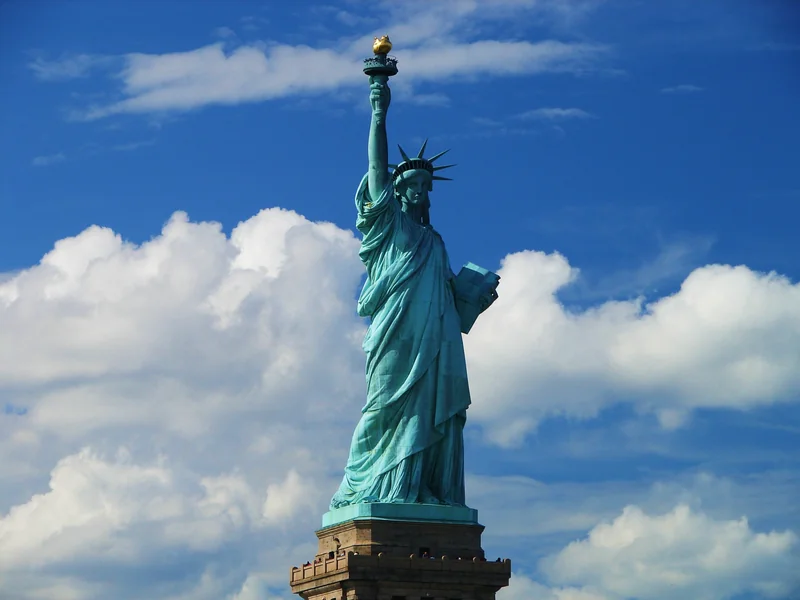
New York County · Manhattan
The Statue of Liberty stands 305 feet from the base of the pedestal to the tip of the torch — the statue itself is 154 feet. Crown access requires climbing 354 stairs inside the statue with limited capacity; tickets sell out 3–6 months in advance. Pedestal access books 1–3 months out. Grounds-only admission is lower and more available, though still popular.
Ellis Island is included on the same ferry ticket. The Immigration Museum documents the 12 million people who passed through between 1892 and 1954 — the arrival hall — a 56,000-square-foot vaulted registry room — is a standalone reason to visit. Allow a full day for both islands. The ferry from Battery Park runs approximately every 30 minutes.
Watch on YouTube · View on Google Maps
Times Square Must-see
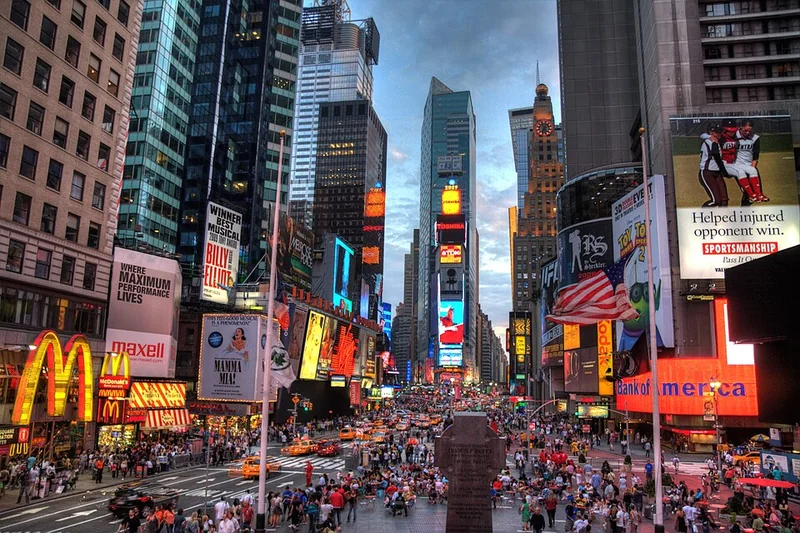
New York County · Manhattan
The intersection of Broadway and 7th Avenue between 42nd and 47th Streets draws over 330,000 visitors daily — making it the most-visited tourist destination in the United States by daily foot traffic. The neon and LED advertising is visible from blocks away; at night the illumination is bright enough to read by. The pedestrian plazas added in 2009 made the experience significantly more walkable.
Times Square is a place to walk through, not just photograph. The theater ticket booth (TKTS) at the north end of the red stairs sells same-day and next-day Broadway tickets at 20–50% discount. Get there by 11am for matinee shows and by 3pm for evenings. The surrounding blocks have every restaurant chain in existence; wander 6 blocks in any direction for actual New York food.
Watch on YouTube · View on Google Maps
Central Park Must-see
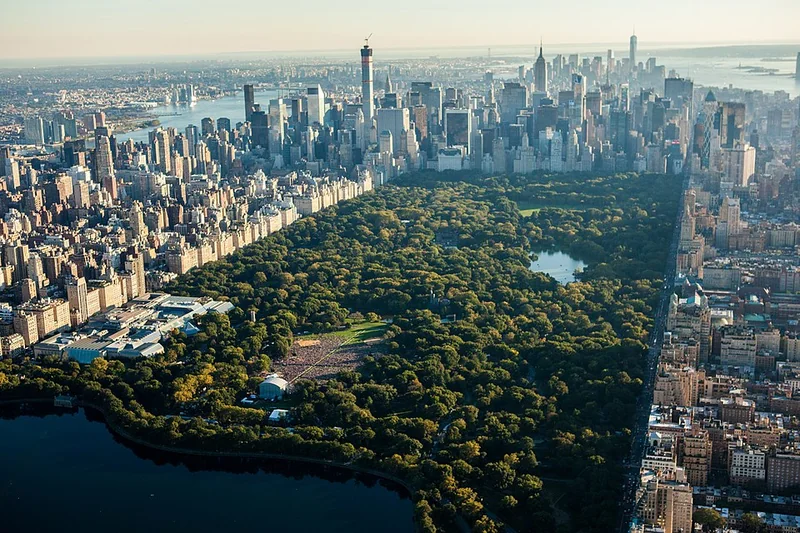
New York County · Manhattan
843 acres in the middle of Manhattan, designed by Frederick Law Olmsted and Calvert Vaux and completed in 1873. The park has 37 miles of pathways, 21,000 trees, 7 bodies of water, a zoo, a carousel, and a bandshell that hosts the New York Philharmonic's free summer concerts. The Great Lawn holds 100,000 people for those events.
The Ramble — 36 acres of intentionally wild woodland in the park's midsection — is the top urban birding destination in the eastern United States during spring and fall migration. The Reservoir running loop (1.58 miles) around the Jacqueline Kennedy Onassis Reservoir is the most used running route in New York City. Enter from 72nd Street on the east or west side for the most-visited sections.
Watch on YouTube · View on Google Maps
Western New York
Niagara Falls State Park Must-see
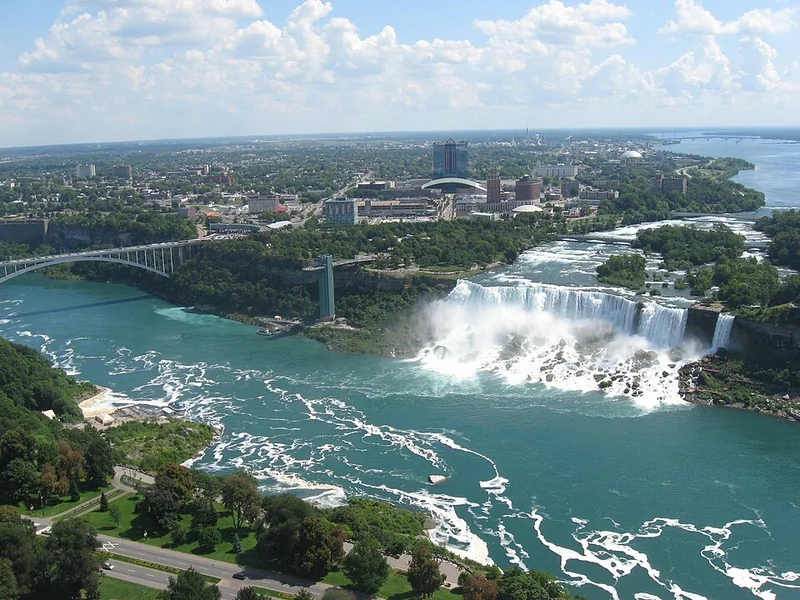
Niagara County · Niagara Falls
The oldest state park in the US, established 1885, preserves the American Falls (70–110 feet) and Bridal Veil Falls (78 feet) on the New York side of the border. Horseshoe Falls — the largest of the three falls — is on the Canadian side but visible from Prospect Point on the American shore. The Maid of the Mist boat tour departs from the base of the American Falls and goes directly into the spray at the base of Horseshoe Falls.
The Cave of the Winds tour descends to the base of Bridal Veil Falls via elevator and wooden walkway; the Hurricane Deck platform gets within 20 feet of the falls. Both tours close in winter. If crossing into Canada is possible, budget a separate day — the view from the Canadian side is considerably wider. The park is walkable from the Niagara Falls city center.
Watch on YouTube · View on Google Maps
USA Travel Planner — Google Sheets
One purchase. Every US state. Forever.
A pre-filled travel dashboard for every US state — we are actively building them out.
- 75+ curated attractions — pre-researched for you
- Built-in budget tracker (countdown, expenses, remaining)
- Step-by-step planning tabs
- Buy once — get all future states free as they launch
Adirondacks & North Country
Adirondack Park & High Peaks Wilderness Must-see
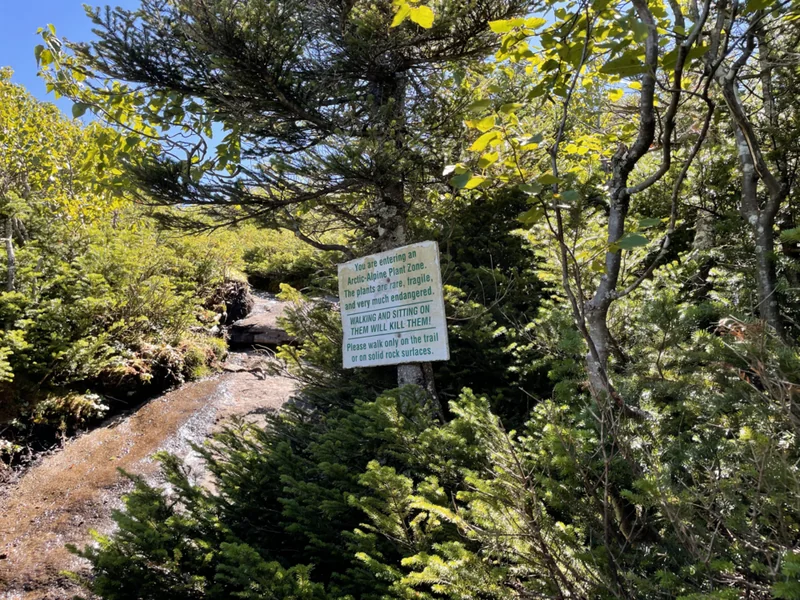
Essex County · Lake Placid
At 6.1 million acres, Adirondack Park is the largest park in the contiguous United States — larger than Yellowstone, Yosemite, Grand Canyon, and Glacier National Parks combined. The High Peaks Wilderness in Essex County has 46 summits above 4,000 feet; summiting all 46 is a serious mountaineering undertaking that draws dedicated peak-baggers from across the country. Mount Marcy at 5,344 feet is the state's highest point.
Lake Placid, which hosted the 1932 and 1980 Winter Olympics, is the most practical base. Reservations are required at several popular High Peaks trailheads (including Adirondack Loj) between May 1 and November 14 — book through the DEC's system. The easier 46th peak on the list requires an 8-mile round trip with 3,000 feet of gain; the hardest require technical equipment and navigation.
Watch on YouTube · View on Google Maps
Thousand Islands & Boldt Castle Must-see
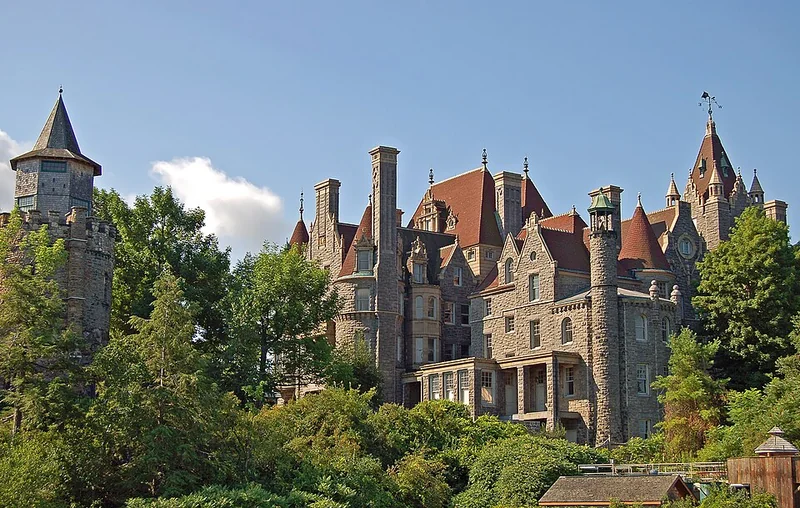
Jefferson County · Alexandria Bay
1,864 islands spanning 50 miles of the St. Lawrence River between New York and Ontario. Boldt Castle on Heart Island is the most visited: millionaire George Boldt began building the six-story Rhineland-style castle in 1900 as a gift for his wife, then halted construction permanently when she died in 1904. It sat unfinished for 73 years before the Thousand Islands Bridge Authority took over restoration in 1977.
Boat tours from Alexandria Bay and Clayton reach Heart Island with castle access. The 1000 Islands International Tourism Council offers many tour options; summer weekends book out. The region also has excellent fishing, kayaking, and a wine trail on the New York side. Drive the 1000 Islands Parkway in Ontario for the longest views.
Watch on YouTube · View on Google Maps
Finger Lakes & Eastern Long Island
Finger Lakes Wine Country Must-see
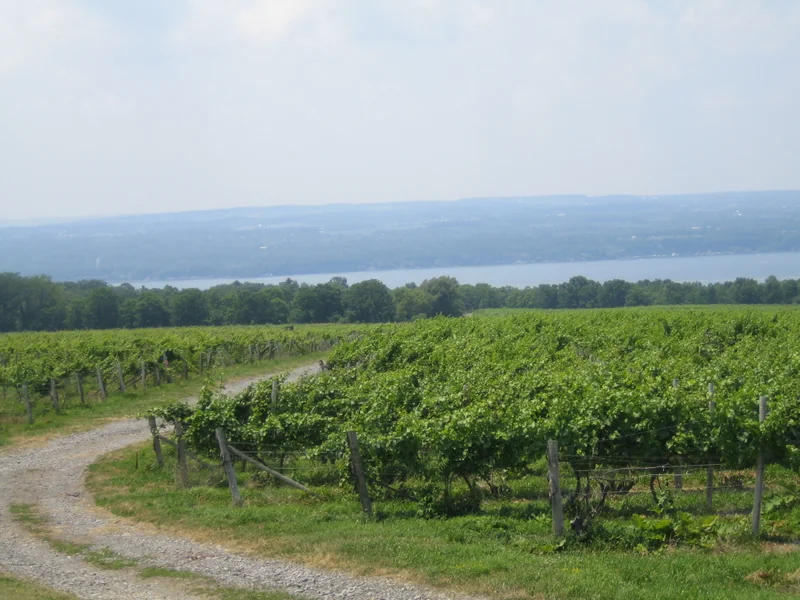
Schuyler County · Watkins Glen
11 deep glacially carved lakes surrounded by over 100 wineries, producing Riesling, Gewürztraminer, and Cabernet Franc at a quality level that now competes internationally. Seneca and Cayuga Lakes are the largest and have the greatest concentration of wineries. The Seneca Lake Wine Trail alone has 35 member wineries in a 63-mile loop.
Watkins Glen at the southern tip of Seneca Lake serves as the region's hub — the gorge state park is within walking distance of downtown. Most wineries are open May through October with reduced hours in winter. A designated driver or booked wine tour is practical — the roads are narrow and rural. Book winery visits on weekday mornings to avoid weekend crowds.
Watch on YouTube · View on Google Maps
The Hamptons Must-see
Suffolk County · Southampton
A string of beach towns on the South Fork of Long Island stretching 70+ miles of Atlantic coastline. Southampton, East Hampton, Bridgehampton, Sag Harbor, and Montauk each have a distinct character — the Hamptons is not one place but a region. The beaches themselves are public and free; the social and hospitality economy around them is expensive by almost any standard.
Montauk, the easternmost point, has a working fishing fleet, a historic lighthouse (1796, the fourth-oldest in the country), and a less precious atmosphere than the Hamptons' core towns. The Sunrise Highway/Route 27 gets heavily congested on summer Friday afternoons — arrive Thursday evening or plan for Long Island Rail Road service from Penn Station.
Watch on YouTube · View on Google Maps
Saratoga Springs (Spa, Racing & Arts) Must-see
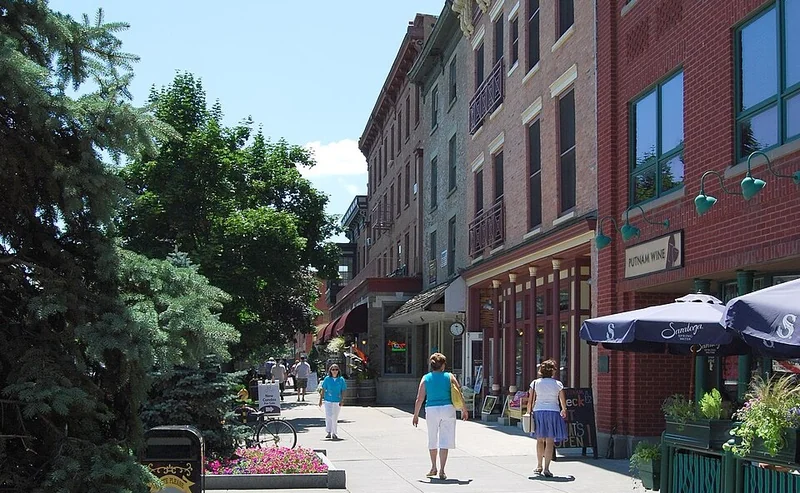
Saratoga County · Saratoga Springs
Saratoga Springs packages three distinct appeals: the Saratoga Race Course (the oldest thoroughbred track in America, operating since 1863, running July through Labor Day), the Saratoga Spa State Park with its original 1930s therapeutic mineral springs bathhouses, and a performing arts center that hosts the New York City Ballet and Philadelphia Orchestra in summer.
The six-week racing season (late July through Labor Day) is peak Saratoga — reserved parking and grandstand admission required. The Fasig-Tipton yearling sales in August draw international horse buyers. Outside racing season, the spa park and Broadway commercial district are relaxed and walkable. The mineral springs at Hathorn Spring #1 are free to visit and taste year-round.
Watch on YouTube · View on Google Maps
Planning Notes
Booking ahead: Statue of Liberty crown tickets sell out 3–6 months ahead; book the day your travel date opens on recreation.gov. Adirondack High Peaks trailhead reservations (May–November) book through the NYS DEC. Maid of the Mist and Cave of the Winds at Niagara Falls are walk-in but have long lines in summer — arrive before 9am.
Getting around: NYC attractions are subway-accessible. Everything else requires a car. Niagara Falls is 6 hours from NYC by car; Adirondacks and Thousand Islands are 4–5 hours north. The Finger Lakes and Saratoga Springs are 3–4 hours from the city. Long Island's South Fork (Hamptons) is 2.5 hours on the Long Island Expressway or 2 hours on the LIRR to Montauk.
Plan your visit: City guides cover the key destinations in detail: Manhattan for Times Square, Statue of Liberty, and Central Park; Saratoga Springs for the racing and arts season; Watkins Glen for the Finger Lakes wine and gorge experience.