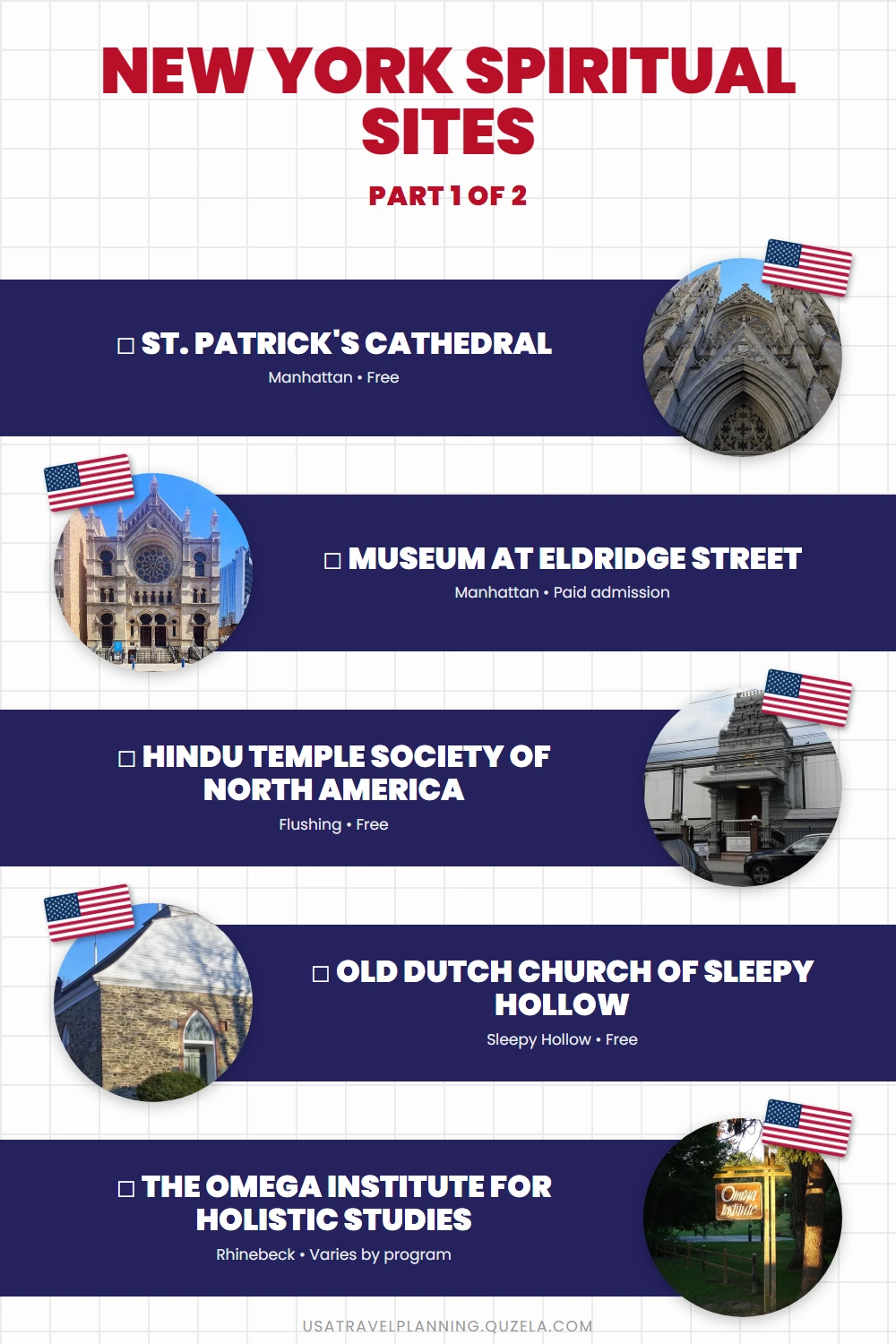
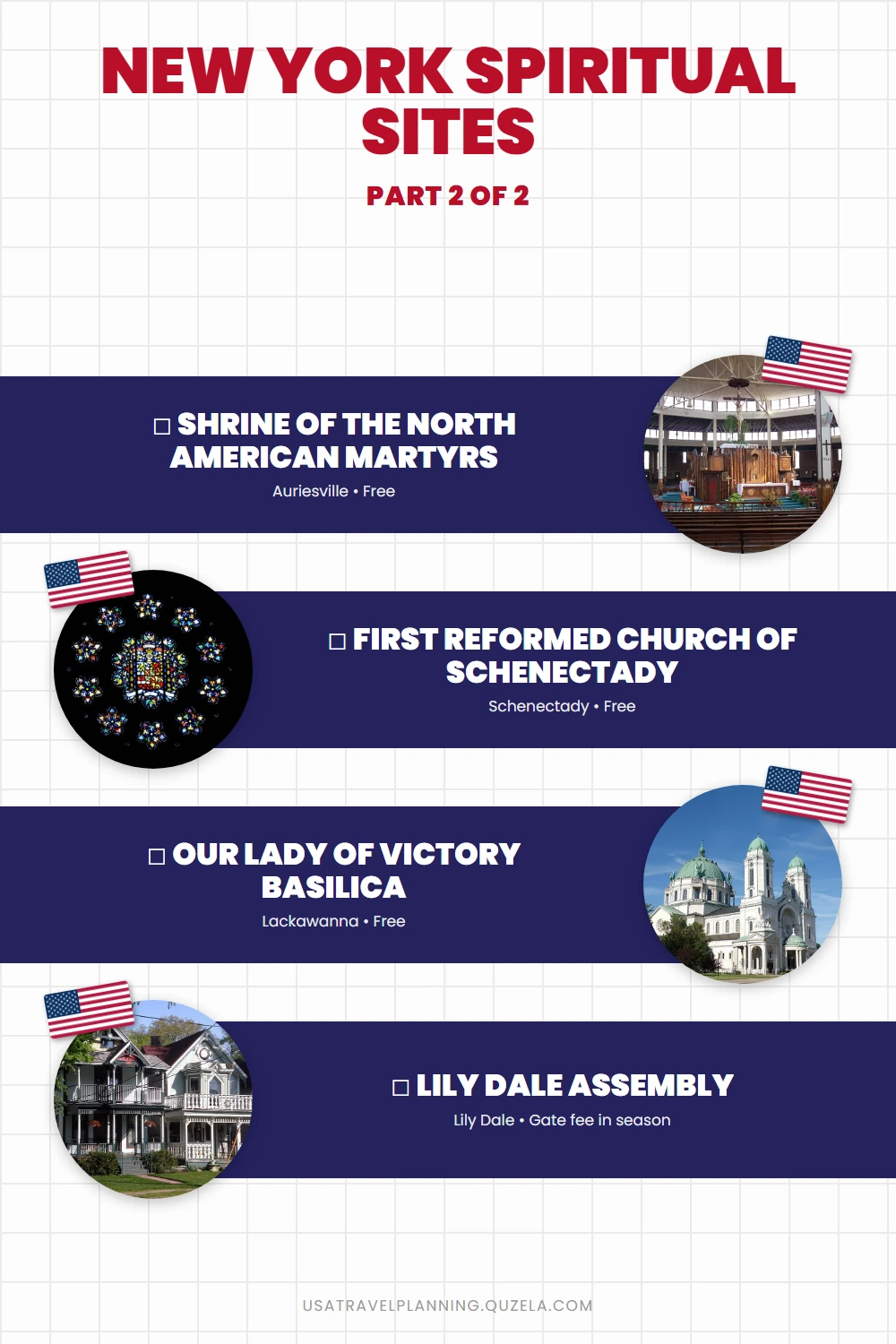
New York's religious landscape is as diverse as its population. The state has the country's first traditional Hindu temple, a Victorian Spiritualist community that has been operating for nearly 150 years, the largest Gothic Revival Catholic cathedral in North America, and a congregation that has used the same building continuously since 1680.
These nine sites represent that range — from mainstream landmarks to places you'd only know if you were specifically looking for them.
9 destinations selected from a curated US travel dataset — prioritized by regional distribution, visitor significance, and independent research. Must-see and Worth-the-detour ratings reflect relative value within New_york.
Jump to: New York City · Hudson Valley & Sleepy Hollow · Capital Region · Western New York · Planning Notes
New York City
St. Patrick's Cathedral Must-see
New York County · Manhattan
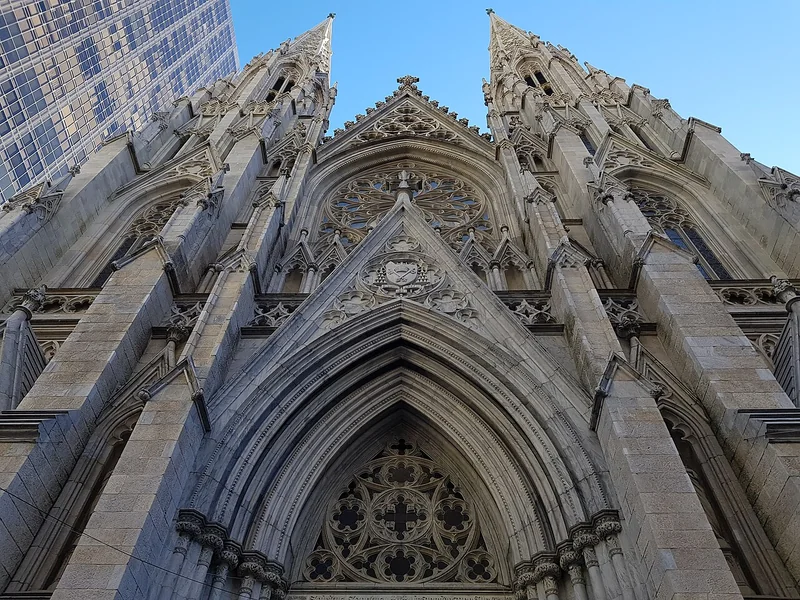
Gothic Revival cathedral on Fifth Avenue completed in 1879, seating 2,200 in a nave flanked by side chapels and stained glass lancet windows. The twin spires reach 330 feet. The cathedral is the seat of the Archdiocese of New York and the largest Gothic Revival Catholic cathedral in North America. Masses run throughout the day; the 10:15am Sunday High Mass includes full choir.
Entry is free. Security screening runs continuously; expect a short wait during peak tourist hours (10am–4pm). The Lady Chapel behind the main altar is a quieter space. St. Patrick's Day Mass draws the largest annual crowd — arrive by 9am for seating.
Watch on YouTube · View on Google Maps
Museum at Eldridge Street (1887 Synagogue) Must-see
New York County · Manhattan
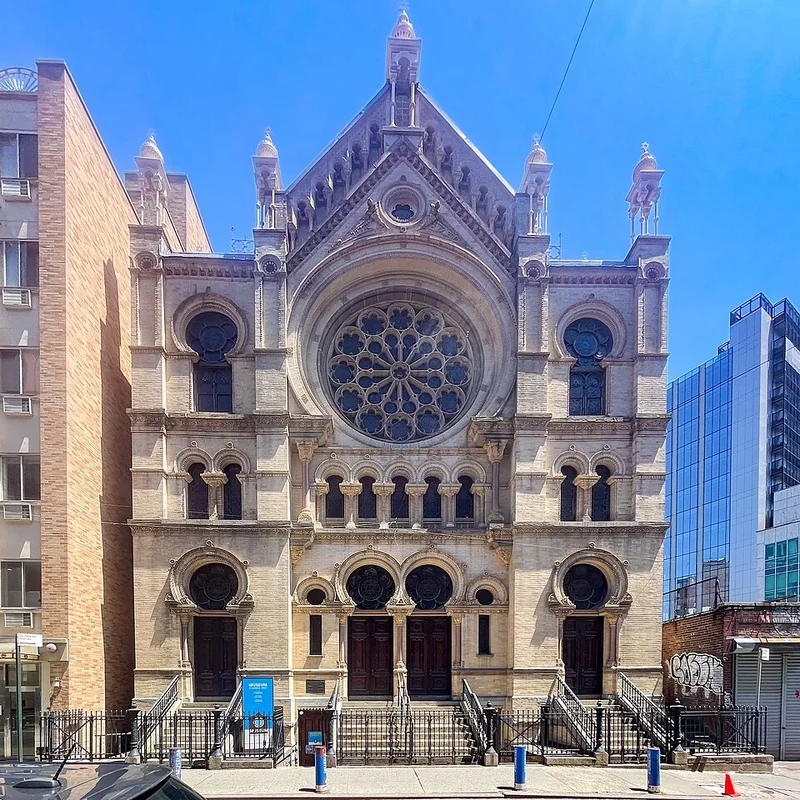
Built in 1887 by Eastern European Jewish immigrants, Eldridge Street Synagogue was the first major synagogue constructed in the United States by Ashkenazi Jews from Eastern Europe. The main sanctuary has a 50-foot vaulted ceiling, Moorish-influenced ornament, and a 1892 stained glass east window restored in 2010 by artist Kiki Smith — the new window incorporates a Star of David and modern geometric forms visible against the 19th-century surroundings.
The synagogue declined with the Lower East Side's population shifts and sat dormant for decades before the Eldridge Street Project began restoration in 1986. Guided tours run Thursday through Sunday; the building is on the Lower East Side 2 blocks from the Essex Street Market.
Watch on YouTube · View on Google Maps
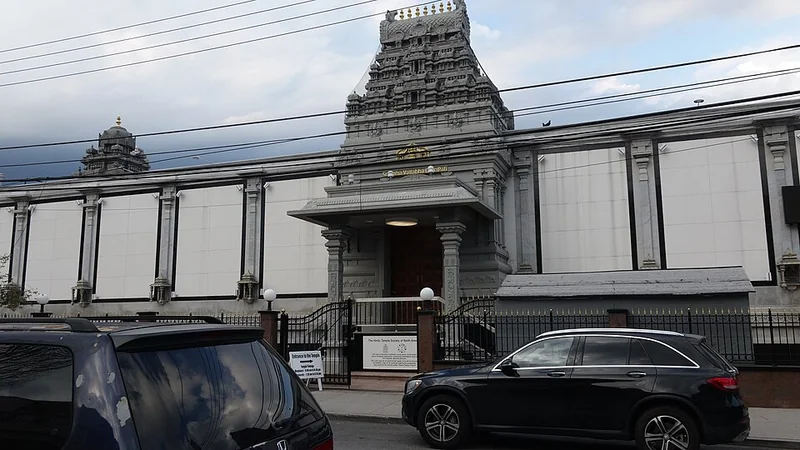
Hindu Temple Society of North America (Queens) Must-see
Queens County · Flushing
Founded in 1977 as the first traditional Hindu temple in the United States, built according to ancient Agamic scriptures with artisans brought from India. The temple is dedicated to Lord Ganesh and features granite sculptures carved in Tamil Nadu. Daily pujas (ritual worship) follow the traditional Agamic schedule; visitors are welcome to observe.
The temple is in Flushing, Queens — the most religiously diverse neighborhood in New York City, with temples, mosques, churches, and synagogues within a few blocks. Remove shoes before entering. Photography inside the main shrine hall is at the discretion of the priests on duty.
Watch on YouTube · View on Google Maps
Hudson Valley & Sleepy Hollow
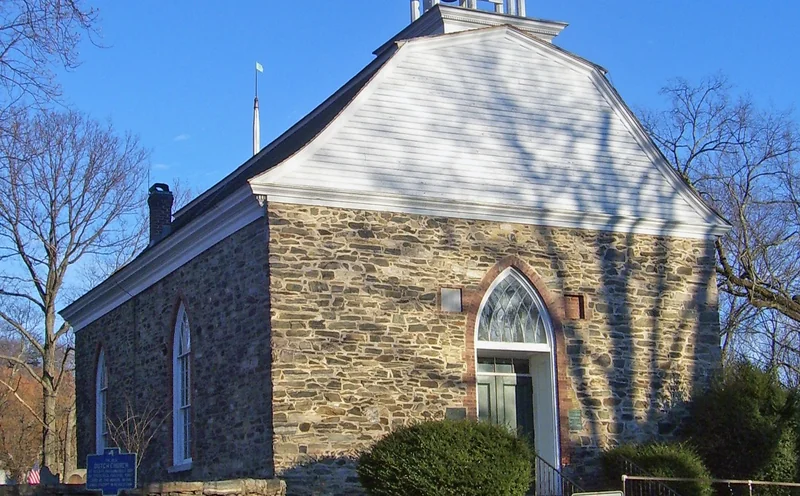
Old Dutch Church of Sleepy Hollow (1685) Must-see
Westchester County · Sleepy Hollow
Built in 1685, the Old Dutch Church is the oldest church in New York still standing in its original form. The graveyard beside it was made famous by Washington Irving's 1820 story 'The Legend of Sleepy Hollow' — Irving himself is buried across the road in the larger Sleepy Hollow Cemetery. The church still holds a regular Sunday service.
Sleepy Hollow leans into the Halloween season heavily: lantern tours, harvest festivals, and a haunted horseman event run through October. The church and cemetery are walkable; the village is on Metro-North's Hudson Line, 30 miles north of Grand Central.
Watch on YouTube · View on Google Maps
The Omega Institute for Holistic Studies Worth the detour
Dutchess County · Rhinebeck
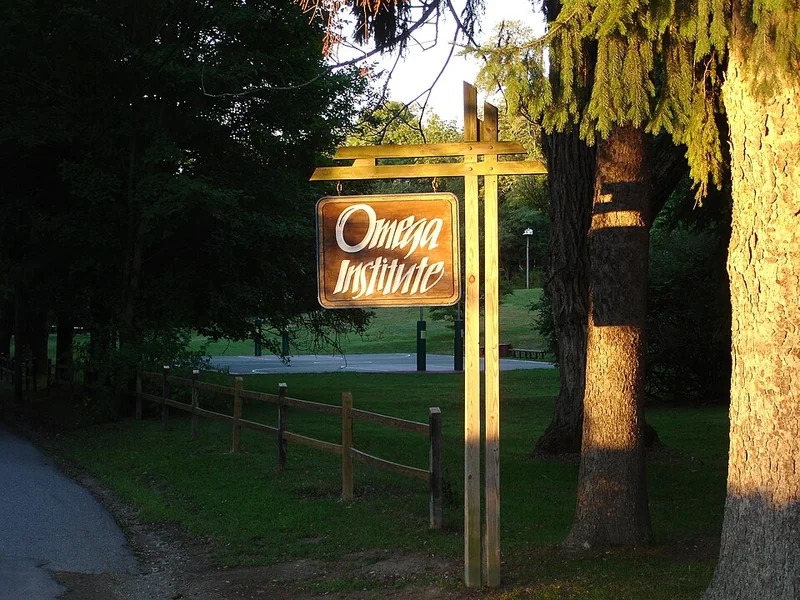
A 195-acre educational retreat campus in Rhinebeck, founded in 1977. Omega runs 400+ workshops annually on topics ranging from yoga teacher training and Zen Buddhism to creative writing and social justice — drawing speakers and practitioners from across the country. The campus includes a meditation sanctuary, sustainable farm, and lakefront.
Day passes are available when programs are in session, giving access to the grounds, dining hall, and some public events. Residential programs range from weekend rates to week-long intensives. The campus is 100 miles from NYC; Rhinebeck itself is a small Hudson Valley town with good restaurants and independent shops.
Watch on YouTube · View on Google Maps
USA Travel Planner — Google Sheets
One purchase. Every US state. Forever.
A pre-filled travel dashboard for every US state — we are actively building them out.
- 75+ curated attractions — pre-researched for you
- Built-in budget tracker (countdown, expenses, remaining)
- Step-by-step planning tabs
- Buy once — get all future states free as they launch
Capital Region
Shrine of the North American Martyrs (Auriesville) Worth the detour
Montgomery County · Auriesville
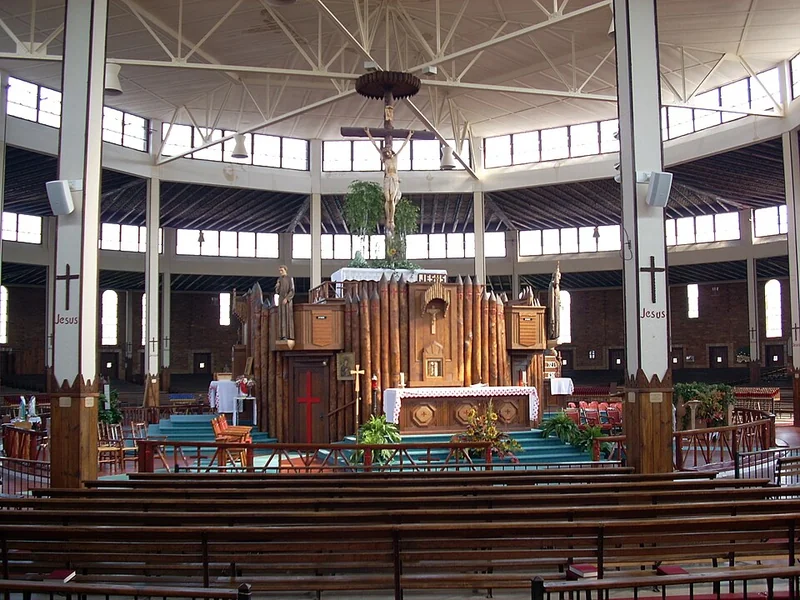
The site where French Jesuit missionary Isaac Jogues was killed in 1646 by members of the Mohawk Nation during the Beaver Wars. Jogues and seven companions were canonized by Pope Pius XI in 1930 as the North American Martyrs. The shrine grounds include a Colosseum church seating 6,500 — the largest church in New York State by capacity, a ravine chapel marking the traditional site of Kateri Tekakwitha's birth, and walking paths through the hilltop property.
The shrine is in Montgomery County near the town of Fonda, 40 miles west of Albany. Open May through October. The Tekakwitha connection is theologically significant — Kateri Tekakwitha, a Mohawk woman canonized in 2012, was the first indigenous North American saint.
Watch on YouTube · View on Google Maps
First Reformed Church of Schenectady (Founded 1680) Worth the detour
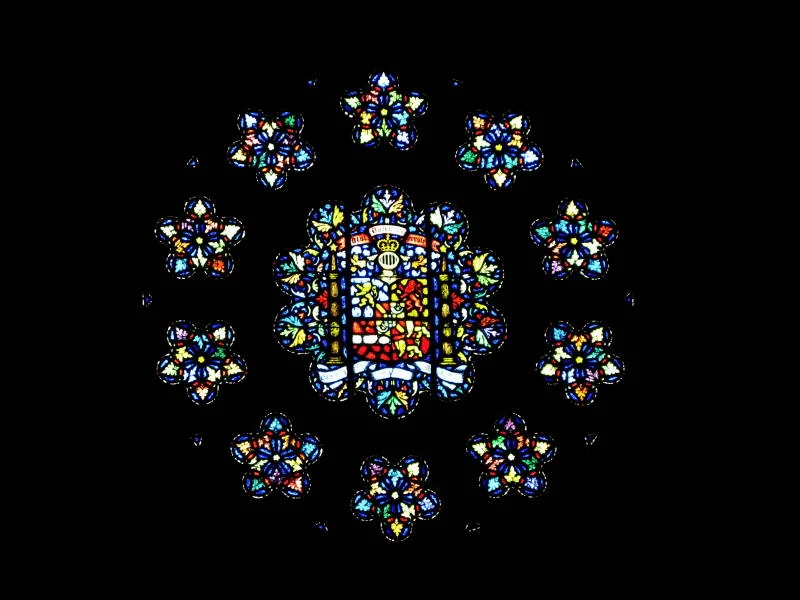
Schenectady County · Schenectady
The oldest congregation in America continuously occupying the same building, founded by Dutch settlers in 1680. The current structure dates from 1862 (the third on the site after two earlier buildings burned) but the congregation has been continuous since the colonial period. The church is in the Stockade Historic District, Schenectady's original settlement bounded by the Mohawk River.
The Stockade district has 17th and 18th-century homes in the most intact Dutch colonial street layout surviving from the 17th century. Schenectady is 30 minutes from Albany by car, or accessible on Amtrak's Empire Service from Penn Station.
Watch on YouTube · View on Google Maps
Western New York
Our Lady of Victory Basilica (Lackawanna) Must-see
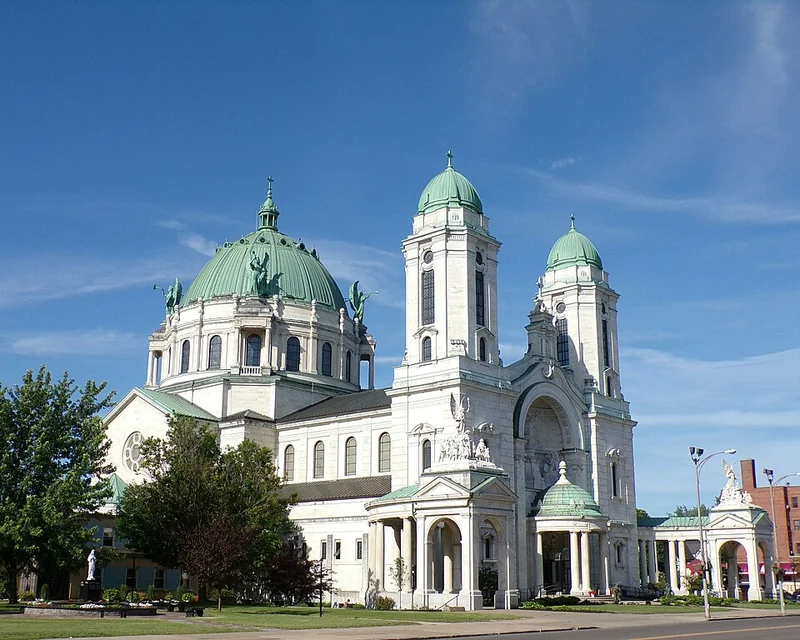
Erie County · Lackawanna
Completed in 1926, Our Lady of Victory Basilica was the first minor basilica east of the Mississippi River. The Italian Baroque building was designed by Cram and Ferguson and funded entirely by Father Nelson Baker, who led the parish for 50 years. The dome interior contains detailed mosaics; the exterior features paired towers and a bronze entrance trellis. Pope Pius XI elevated it to basilica status the same year it was completed.
The basilica is in Lackawanna, a small city 5 miles south of Buffalo, and is free to enter. The adjacent Our Lady of Victory National Shrine and Basilica complex includes a shrine to Father Baker — underway for potential beatification. Parking is available on-site.
Watch on YouTube · View on Google Maps
Lily Dale Assembly (World's Largest Spiritualist Community) Must-see
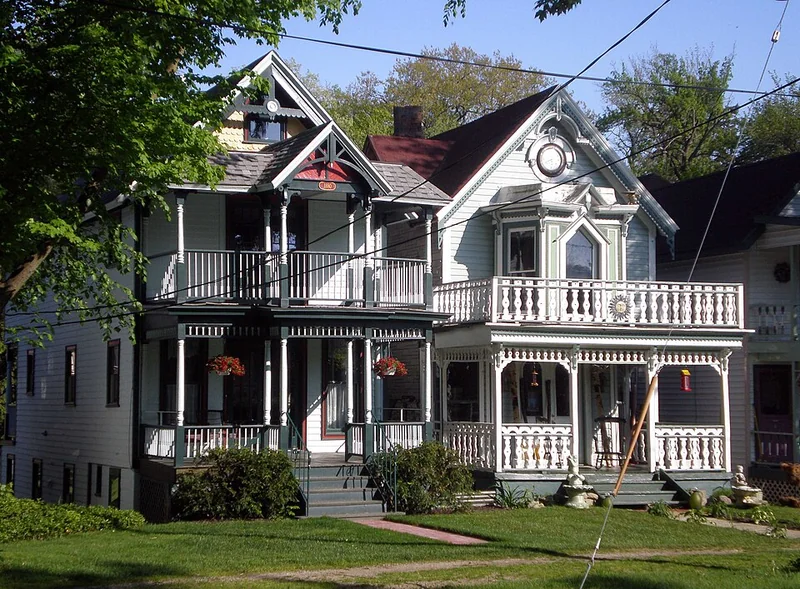
Chautauqua County · Lily Dale
Founded in 1879, Lily Dale is the largest active Spiritualist community in the world — 50 acres on Cassadaga Lake in Chautauqua County, with Victorian cottages, registered mediums, and a daily schedule of public message services, lectures, and healing workshops from late June through August. About 40 registered mediums live and work on the grounds during the season.
The gate fee covers access to the grounds and public demonstrations at the Stump (an outdoor gathering area under old-growth trees). Individual readings with mediums cost $50–100+ and should be booked directly. Off-season, Lily Dale is a quiet residential community; the Forest Temple and Leolyn Woods are accessible year-round. The town is 60 miles south of Buffalo.
Watch on YouTube · View on Google Maps
Planning Notes
Best times: Lily Dale's season runs June through August — outside those months, the mediums are gone and the gate is open to walk the grounds freely. Omega Institute runs programs April through December. The Old Dutch Church and Sleepy Hollow Cemetery are best in October. All Catholic and Reformed churches are open year-round.
Plan your visit: City guides cover the destinations with the most concentrated sites: Manhattan for St. Patrick's Cathedral and Eldridge Street, Buffalo for Our Lady of Victory Basilica in Lackawanna, Hyde Park for the Rhinebeck Omega Institute.