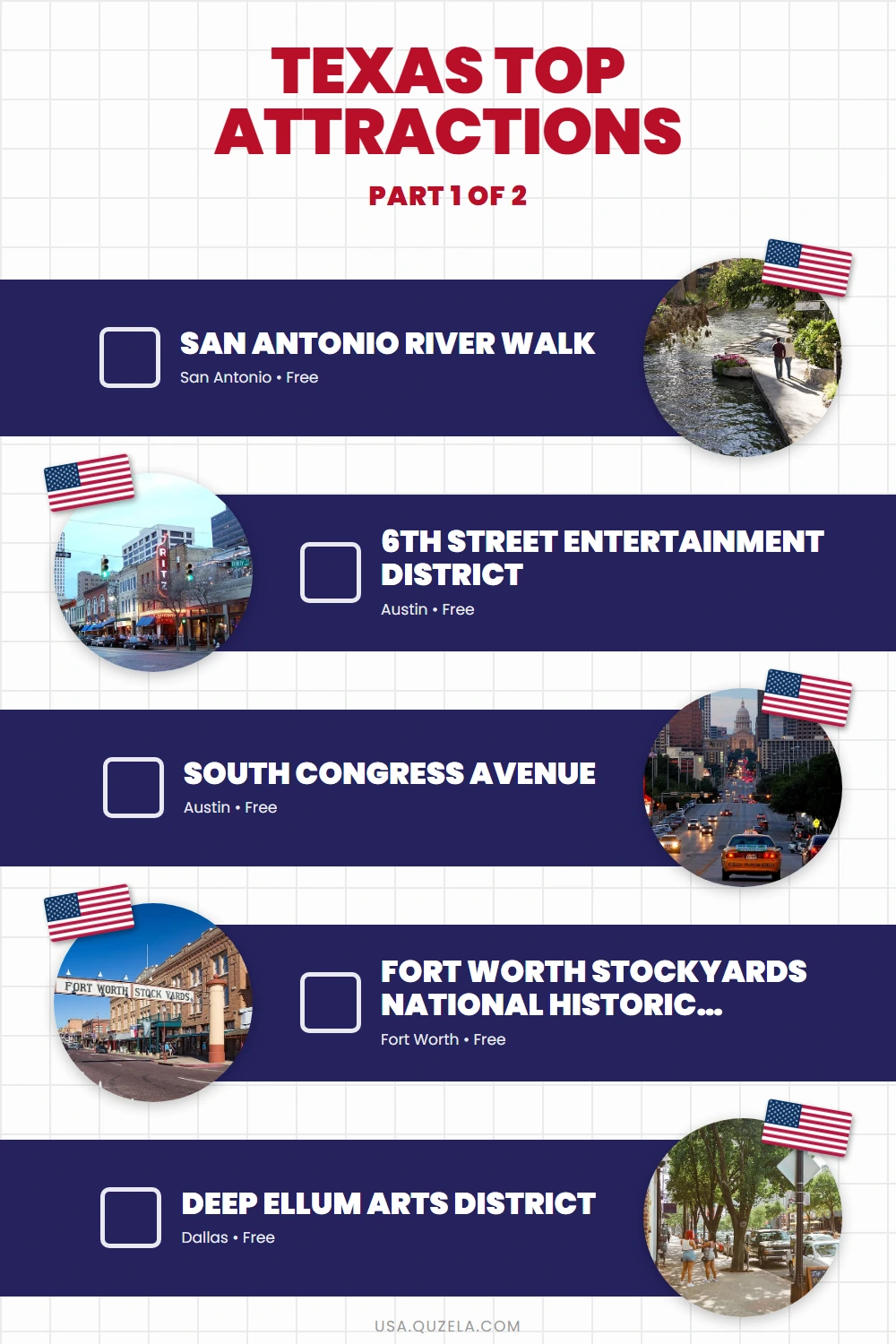
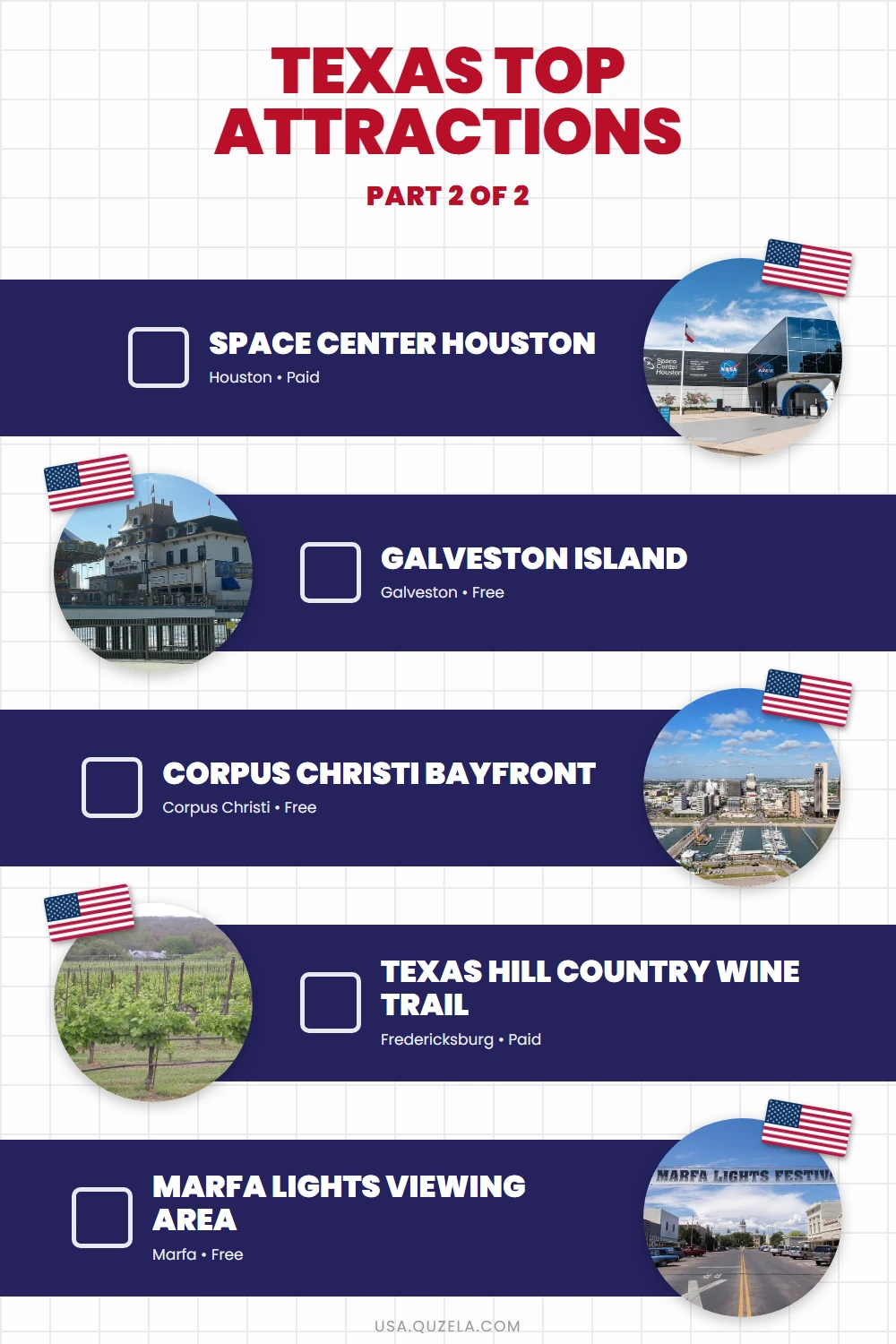
Texas covers 268,596 square miles — larger than France — and the drive from El Paso to Houston takes more than 10 hours without stops. These 10 attractions give a region-by-region framework before you commit to a route: the River Walk and Stockyards anchor the west and north, 6th Street and South Congress define the capital, Space Center Houston and Galveston define the Gulf, and Marfa Lights in the far west are in a category no one has explained. Pick your region, then use the city guides linked at the bottom to plan the details.
10 destinations selected from a curated US travel dataset — prioritized by regional distribution, visitor significance, and independent research. Must-see and Worth-the-detour ratings reflect relative value within Texas.
Jump to: City Neighborhoods & Cultural Districts · Houston & the Gulf Coast · Hill Country & West Texas · Planning Notes
City Neighborhoods & Cultural Districts
Texas's best-known districts are free to walk and graze — the draw is the concentration of restaurants, live music, and street life, not a ticketed experience.
San Antonio River Walk Must-see
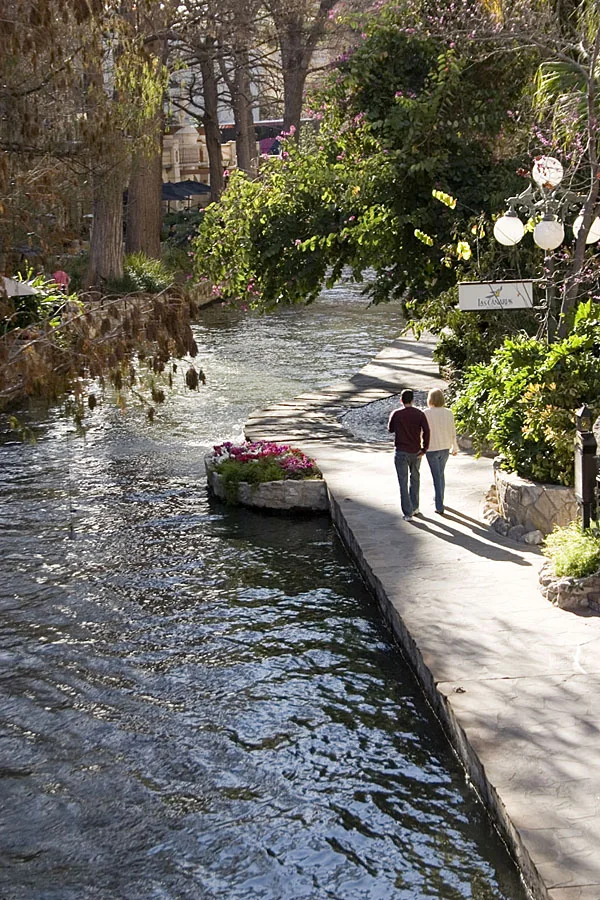
Bexar County · San Antonio
The San Antonio River Walk is a 15-mile network of limestone paths that runs one level below street traffic through downtown San Antonio, following the San Antonio River through the city center. More than 50 restaurants, hotels, and bars line the canal; the Museum Reach extension north of downtown passes public art installations and connects to the Pearl Brewery district. The core tourist loop between Commerce Street and César Chávez Boulevard is about 2.5 miles and takes 45–60 minutes on foot. River taxis run the full 15-mile length ($5 single ride, $15 all-day pass). No admission to walk the path; the River Walk floods occasionally during heavy rain and sections close temporarily. Parking in the downtown garages runs $10–20 per day.
Watch on YouTube · View on Google Maps
6th Street Entertainment District Must-see
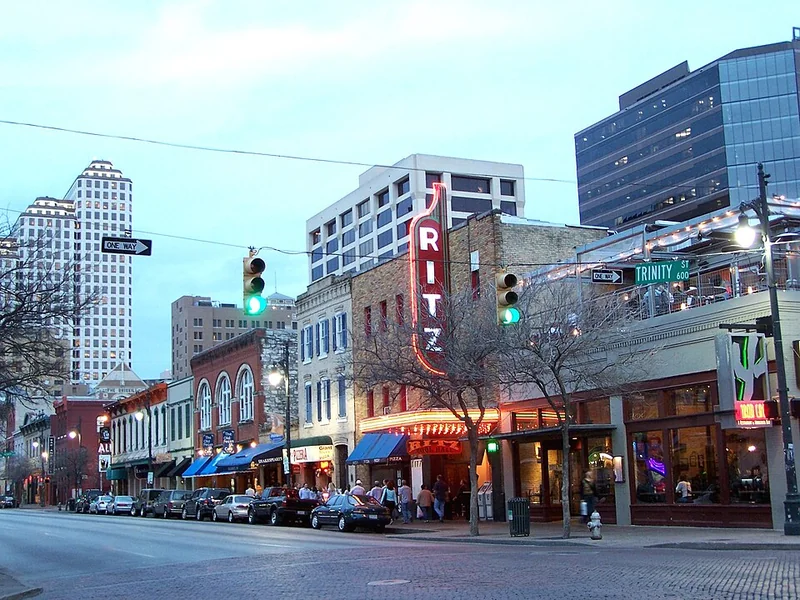
Travis County · Austin
Sixth Street is Austin's live music main drag — six blocks of clubs, bars, and venues between Congress Avenue and I-35 where more than 90 acts play on a given Friday night. The street closes to traffic on weekend evenings, turning into a pedestrian-only scene. Most venues charge a $5–15 cover; the street itself is free to walk. The Rainey Street and Red River Cultural District are parallel alternatives for a younger, more diverse crowd. The east end of 6th Street (East 6th between Congress and 12th) has the most consistent music every night of the week. Live music starts around 9 p.m. and runs to 2 a.m. on weekends.
Watch on YouTube · View on Google Maps
South Congress Avenue Must-see
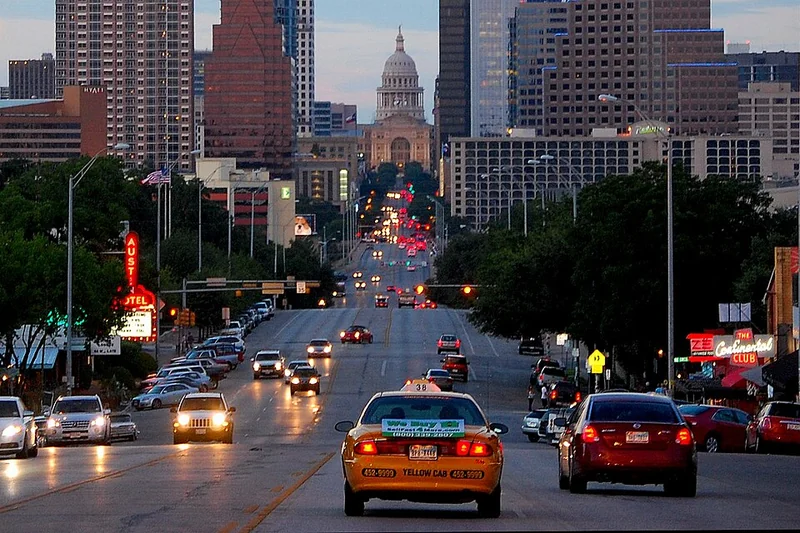
Travis County · Austin
South Congress Avenue — locally called SoCo — runs 2 miles south from the Congress Avenue bridge through a strip of vintage clothing shops, food trailers, independent bookstores, and restaurants that define Austin's neighborhood retail character. The Hotel San José courtyard is a popular day-drinking anchor; Guero's Taco Bar at 1412 S Congress has a 30-year history and regularly hosts live music on the patio. The Amy's Ice Creams location here is the original 1984 store. Parking is metered during business hours along Congress; the nearest garage is under the Arlo Austin hotel. The strip is most alive on weekend afternoons. Free to walk; no ticketed component.
Watch on YouTube · View on Google Maps
Fort Worth Stockyards National Historic District Must-see
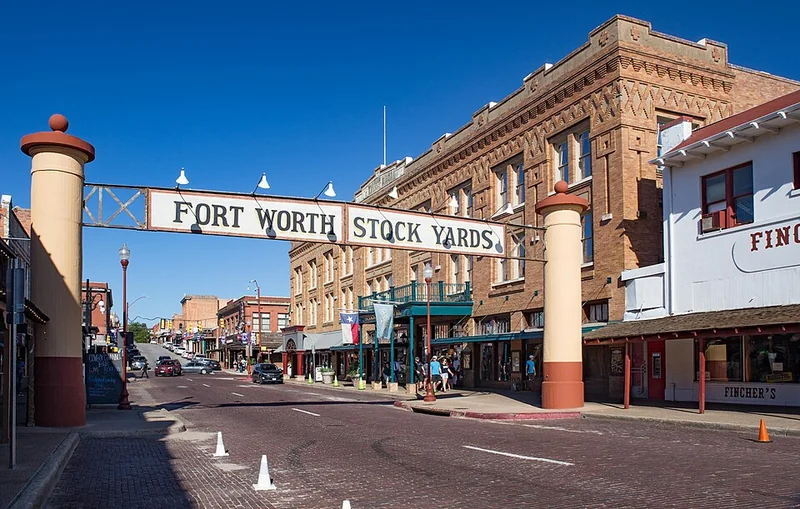
Tarrant County · Fort Worth
The Fort Worth Stockyards is a 98-acre National Historic District that processed 100 million head of cattle between 1866 and the 1970s — the largest livestock market in the world at its peak. Today it runs the world's only scheduled cattle drives: a dozen longhorns walk Exchange Avenue daily at 11:30 a.m. and 4 p.m. at no charge. The Coliseum on the grounds hosts the weekly Stockyards Championship Rodeo every Friday and Saturday night ($20–25/ticket). Billy Bob's Texas — a 127,000 square-foot honky-tonk with live bull riding and a 6,000-person capacity — is the largest honky-tonk in the world, charging $5–15 cover depending on the night's act. The district is 1.5 miles north of downtown Fort Worth on Exchange Avenue.
Watch on YouTube · View on Google Maps
Deep Ellum Arts District Must-see
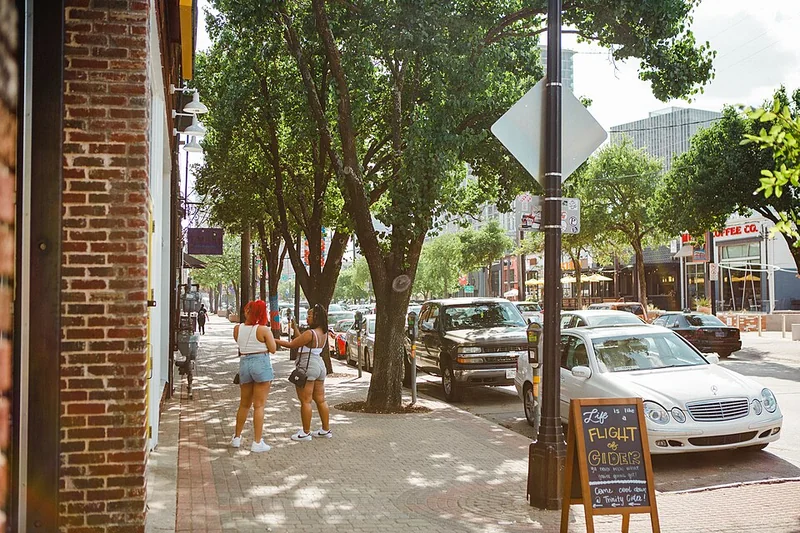
Dallas County · Dallas
Deep Ellum is a 20-block arts and music district east of downtown Dallas that was home to Texas blues and jazz in the 1920s and has cycled through multiple creative revivals since. Today it holds over 60 murals, 30+ live music venues, and some of Dallas's best independent restaurants and bars concentrated between Commerce Street and Main Street east of Good-Latimer Expressway. The Trees and Ruins are the main concert venues for mid-size national acts ($15–50/ticket depending on the show). Murals by local and international artists cover most exterior walls — the large-format pieces on Elm and Main are the most photographed. Free to walk; venues charge individual cover. Park in the lot at Good-Latimer and Commerce for $5–10.
Watch on YouTube · View on Google Maps
Houston & the Gulf Coast
Space Center Houston Must-see
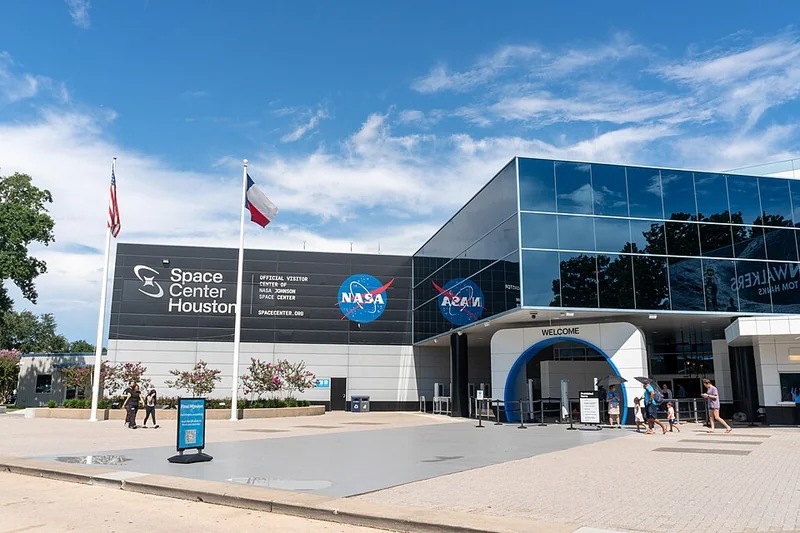
Harris County · Houston
Space Center Houston is NASA's official visitor center for Johnson Space Center, with 14 historic spacecraft including a Gemini capsule, Apollo command modules, and the full Saturn V rocket — 363 feet of Moon-era engineering displayed horizontally in its own building. Tram tours depart throughout the day for the working Johnson Space Center campus and stop at the original Mission Control room (used for Apollo 11 through the early Shuttle era) and the current astronaut training facility. General admission is $35 for adults, $25 for children; tram tours require a separate timed ticket ($7). The center is 25 miles southeast of downtown Houston in Clear Lake City. Buy tickets at least 48 hours ahead on weekends — the Saturn V building and tram tours reach capacity by late morning.
Watch on YouTube · View on Google Maps
Galveston Island Must-see
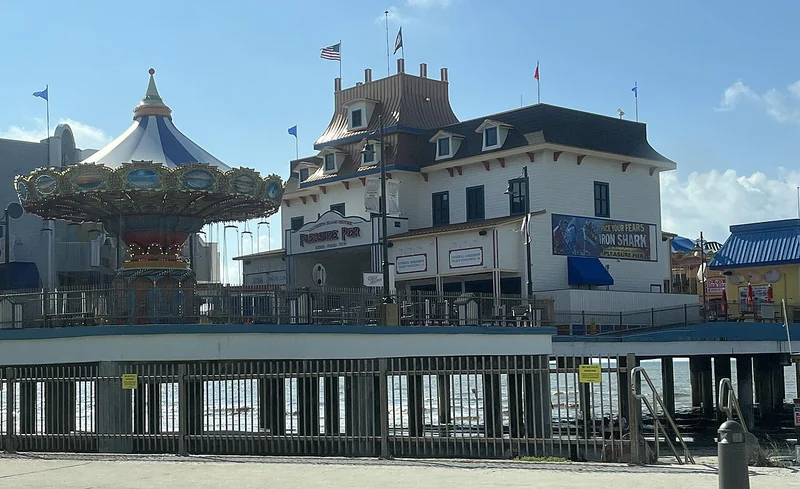
Galveston County · Galveston
Galveston Island is a 32-mile barrier island in the Gulf of Mexico, 50 miles south of Houston, that functions as the Texas Gulf Coast's main resort destination. The Seawall — a 10-mile concrete barrier built after the 1900 hurricane that killed 8,000 people — runs along the south shore and doubles as a flat cycling and walking path with sea views on one side and hotels on the other. The Strand Historic District on the north shore has Victorian commercial buildings from the 1880s, now occupied by restaurants, galleries, and the 1894 Grand Opera House. The East Beach and Stewart Beach areas are the main sand beaches with lifeguards and parking. Free to access the seawall and beaches; parking lots at the main beaches charge $10–15 on weekends.
Watch on YouTube · View on Google Maps
Corpus Christi Bayfront Must-see
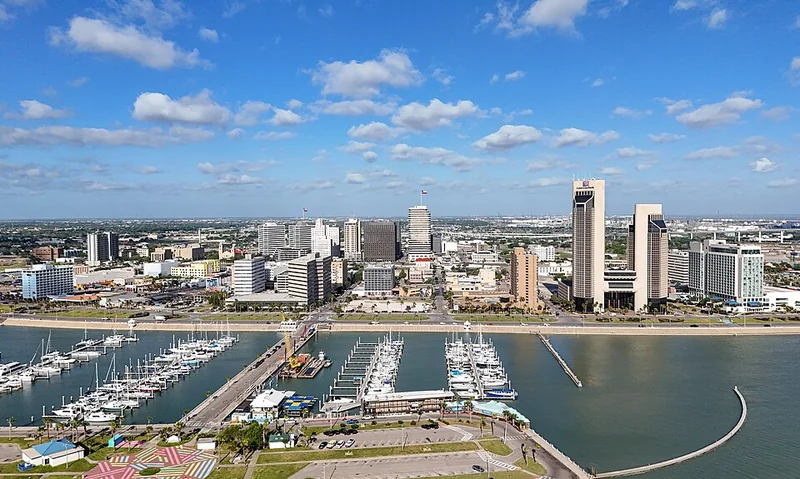
Nueces County · Corpus Christi
The Corpus Christi Bayfront is a 3-mile waterfront promenade along Corpus Christi Bay connecting the city's main attractions: the USS Lexington (a decommissioned WWII aircraft carrier, now a museum, $14 adults), the Texas State Aquarium ($30 adults), and the American Bank Center arena. The T-heads and L-head piers extend into the bay for fishing and marina access. Ocean Drive, the residential boulevard running south from the T-heads, is widely used by cyclists and joggers with an unobstructed bay view for 4 miles. The bayfront itself is free to walk; the Whataburger Field baseball stadium at 734 E Port Ave is 1 mile inland. Wind averages 14–16 mph year-round in Corpus Christi Bay, making it the Gulf Coast's primary windsurfing and kitesurfing destination.
Watch on YouTube · View on Google Maps
USA Travel Planner — Google Sheets
One purchase. Every US state. Forever.
A pre-filled travel dashboard for every US state — we are actively building them out.
- 75+ curated attractions — pre-researched for you
- Built-in budget tracker (countdown, expenses, remaining)
- Step-by-step planning tabs
- Buy once — get all future states free as they launch
Hill Country & West Texas
Texas Hill Country Wine Trail Must-see
Gillespie County · Fredericksburg
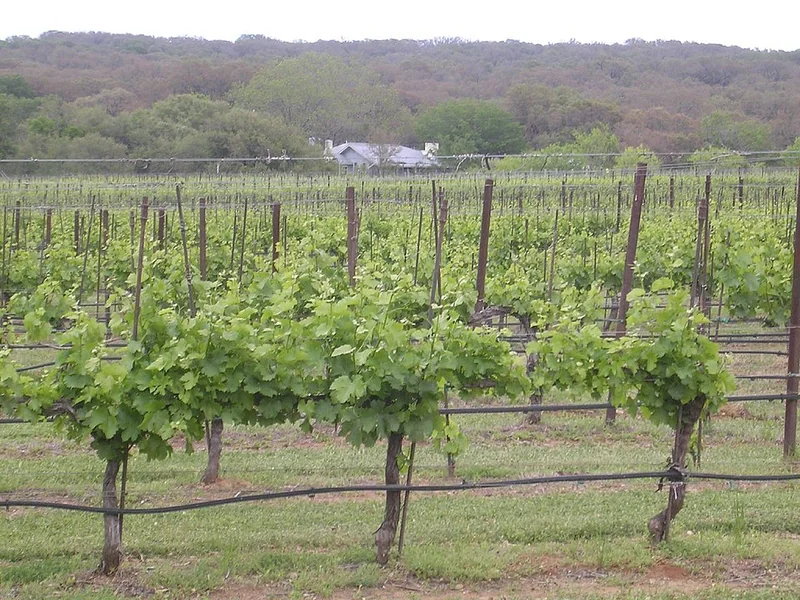
The Texas Hill Country Wine Trail is the second-largest wine region in the United States by vineyard acreage, with more than 50 wineries concentrated within a 40-mile radius of Fredericksburg in Gillespie County. The most-visited corridor runs along US 290 east of Fredericksburg — Grape Creek Vineyards, Becker Vineyards (Texas's largest winery by production), and Pedernales Cellars are the anchors. Most tasting rooms charge $15–25 for a flight of 5–6 pours; weekend visits require reservations at the busier estates. The limestone soil and hot days with cool nights produce Tempranillo and Viognier that outperform the state's earlier reputation for sweet wines. Plan 2–3 wineries per day to allow real conversation with the winemakers. The Fredericksburg AVA was established in 2021, giving the region its own distinct appellation.
Watch on YouTube · View on Google Maps
Marfa Lights Viewing Area Must-see
Presidio County · Marfa
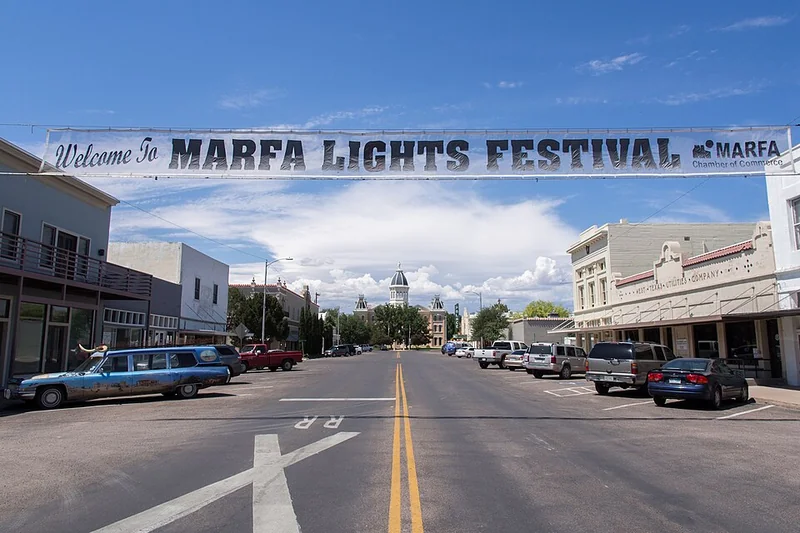
The Marfa Lights Viewing Area is a free roadside pull-off on US 90, 9 miles east of Marfa in Presidio County, where visitors watch unexplained lights appear southeast of the highway on most clear nights. The lights — seen as moving colored orbs that split, merge, and vanish — have been reported by travelers since the 1880s. A 2008 University of Texas study attributed some sightings to car headlights refracting through atmospheric layers, but the orbs predate the automobile era and the explanation doesn't cover the full phenomenon. The viewing platform has interpretive signage and a covered observation shelter. No admission, no hours restriction. Marfa itself is 60 miles southeast of Alpine and 200 miles southeast of El Paso via US 90.
Watch on YouTube · View on Google Maps
Planning Notes
Plan your visit: Each attraction in this article connects to a Texas city guide: San Antonio, Austin, Houston, Dallas, Fort Worth, Fredericksburg, Galveston, and Corpus Christi. Use those guides to find lodging, dining, and additional attractions near each destination.